Showing posts with label web-development. Show all posts

Friday, June 1, 2012

Software design patterns

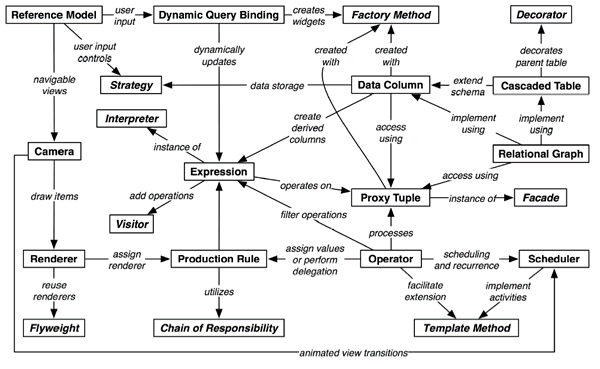
Following a tip from an experienced software developer, I've been reading up on software design patterns: flyweights, factories, facades, etc.  These are general patterns for object-oriented programming that show up again and again.  The original canon included 23 patterns; that list has since expanded to include patterns for networking and multiprocessing.


These design patterns remind me of Go proverbs -- high-level heuristics for better strategy, sometimes contradictory.  Knowing them can be extremely helpful, but it's no guarantee that you can deploy them correctly. (Here's a good list of common go proverbs.)

Anyway, reading the original Design Patterns book, I've had three main reactions:


1. Data-centric software development is going to discover its own list of software design patterns.
2. There are patterns for research design, just like there are patterns for software design.
3. I already know most of the software patterns -- yay!*

Since I just can't sleep tonight, I figured I'd queue up a few blog posts talking about the first two.  Look for those in a couple days.

*Given my very ad hoc background in software design, I've been pleasantly surprised to find that most of the software design patterns are already familiar.  For example, python is already very good with iterators and decorators.  And working with web frameworks has taught me a lot about factories.  And many of the others are much less important in python because objects are dynamically typed.  Anyway, it's nice to discover that I've picked a lot of this up by osmosis.  (Pat self on the back.)

Saturday, January 28, 2012

Announcing QuoteWars2012!

Just in time for the Florida primary, my brother and I have released a site about the 2012 elections: QuoteWars2012.

The site lets you quiz yourself on quotes by Obama, Romney, Gingrich, and other presidential hopefuls.  Think of it as a gamified survey: like a survey, it collects data about public opinion, but it's also designed to be fun and informative.

The site in public beta -- fun and usable, with a few minor bugs.  We're looking for feedback on how to expand and improve the site.  Please play the game, forward far and wide, and let us know what you think!

Thursday, December 29, 2011

Software design for analytics: A manifesto in alpha

If you take the lean startup ideas of quick iteration, learning, and hypothesis checking seriously, then it makes sense to build your software in a way that lends itself to doing analytics.  Lately, I've been doing a lot of both (software development and analytics), so I've been thinking about how to help them play nice together.

Seems to me that MVP/MVC (or even MVVM, if you're into that kind of thing) are good at the following:
  • User experience
  • Database performance
  • Debugging
However, when doing analytics, my needs are different. I need to extract data from the system in a way that lets me answer useful questions. Instead of thinking about performance, scalability, etc., I'm thinking about independent and dependent variables, categories and units of analysis, and causal inference.  The "system requirements" for this kind of thing are very different.

Having worked with (and built) several different systems at this point, I've realized that some designs make analytics easier, and some make them much, much harder. And nothing in general-purpose guidelines for good software design guarantees good design for analytics.

Since so much of what I do is analytics, I'd like to ferret out some best practices for that kind of development.  I don't have any settled ideas yet, but I thought I'd put some observations on paper.

Some general ideas:
  1. Merges are a pain point. When doing analytics, I spend a large fraction of my time merging and converting data. Seems like there ought to be some good practices/tools to take away some of the pain.
  2. Visualization is also a pain point, but I'm less optimistic about fixing it.  There's a lot of art to good visualization.
  3. Units of analysis might be a good place to begin/focus thinking.  They tend to change less often than variables, and many design issues for archiving, merging, reporting, and hypothesis testing focus on units of analysis.
  4. The most important unit of analysis is probably the user, because most leap-of-faith assumptions center on users and markets, and because people are just plain complicated.  In some situations (e.g. B2B), the unit of analysis might be a group or organization, but even then, users are going to play an important role.
  5. Make it easy to keep track of where the data come from!  Any time you change the
  6. From a statistical perspective, we probably want to assume independence all over the place for simplicity -- but be aware that that's what we're doing!  For instance, it might make sense to assume that sessions are independent, even though they're actually linked across users.
  7. User segmentation seems like an underexploited area.  That is, most UI optimization is done using A-B testing, which optimizes for the "average user."  But in many cases, it could be very useful to try to segment the population into sub-populations, and figure out how their needs are different.  This won't work when we only have short interactions with anonymous users.  But if we have some history or background data (e.g. FB graph info), if could be a very powerful tool.
  8. Corollary: grab user data whenever it's cheap.

I'll close with questions.  What else belongs in this list?  Are there other people who are thinking about similar issues?  What process and technical solutions could help?  NoSQL and functional programming come to mind, but I haven't thought through the details.
Tuesday, November 29, 2011

Configuring django with wsgi

In the last couple weeks, I've fallen in love with django. Here are some notes (just for reference) on getting django to talk with R, numpy, and WSGI


#Getting the latest version of R on an older version of ubuntu:
http://cran.r-project.org/bin/linux/ubuntu/README

#Using PIP and VirtualEnv with django
http://www.saltycrane.com/blog/2009/05/notes-using-pip-and-virtualenv-django/

sudo apt-get install python-setuptools python-dev build-essential
pip install numpy
sudo pip install numpy
sudo pip install scipy
sudo pip install rpy2

I never quite cracked this one. It seems that by default, pip doesn't work with the bitnami djangostack. I just used easy_install, with good results.

#Configuring WSGI
http://bitnami.org/forums/forums/djangostack/topics/getting-started
http://serverfault.com/questions/327380/beginner-installing-first-app-on-ec2-bitnami-stack

Neither of these worked perfectly for me, but they got me to the point where I could figure it out.


#Serving static files with WSGI
https://docs.djangoproject.com/en/dev/howto/static-files/
https://docs.djangoproject.com/en/dev/howto/deployment/modwsgi/
https://docs.djangoproject.com/en/dev/howto/deployment/modwsg/#serving-files

Trust the django docs to have a good built-in explanation.

Thursday, October 27, 2011

JSON editors

I've been doing a lot of work with json lately, and realized that it would be handy to have a program to edit and validate json syntax.

Turns out I'm not the first person to see this need.  Here are two nice, in-browser json editors.  Nifty!